

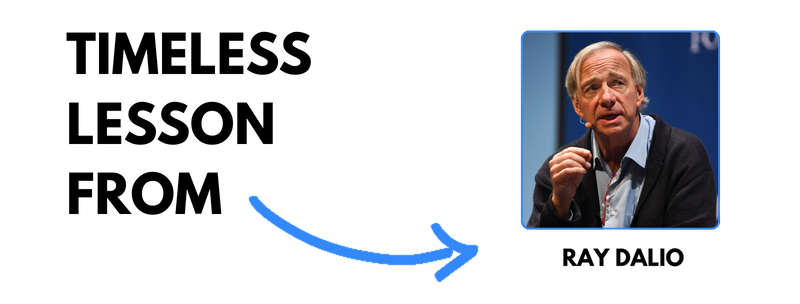
Raymond Dalio was born on 8 August 1949 in Jackson Heights, Queens, New York. The son of a jazz musician, he discovered investing at the age of 12 when he bought shares of Northeast Airlines for $300 and tripled his money after a merger. That early success lit a spark that would shape his career.
Before we continue, a quick word from today’s sponsor:
Wall Street’s Scared—You Should Be Buying
Markets are down, but smart money is circling.
In under 5 minutes, you’ll discover three battered but fundamentally strong picks with massive upside as conditions normalize.
These aren’t flavor-of-the-month names. They’re backed by long-term trends, strong leadership, and ideal entry points created by panic selling.
The dip is real. The opportunity is rare. With AI, cyclical rebounds, and broad exposure, this report gives you an actionable edge. Get in before Wall Street catches on.
Download the FREE report and position yourself for the rebound.

Dalio attended Long Island University before earning an MBA from Harvard Business School in 1973. After graduating, he worked briefly on the floor of the New York Stock Exchange and then as a futures trader at Shearson Hayden Stone.
In 1975, from a two-bedroom apartment in New York, Dalio founded Bridgewater Associates. He started by advising clients on currency and commodity risks, gradually growing the firm into one of the most respected hedge funds in the world.
Dalio’s career was not without setbacks. In 1982, after wrongly predicting a global depression, Bridgewater nearly collapsed. Dalio had to let go of most of his employees and borrow money from his father to stay afloat. The experience humbled him and reshaped how he thought about decision-making.
He rebuilt Bridgewater by developing a culture of “radical transparency,” where employees challenged one another openly and decisions were made by principles rather than hierarchy. Over time, Bridgewater grew into the world’s largest hedge fund, managing more than $150 billion in assets at its peak. Dalio also became known for his book Principles, which distilled his philosophy on life and business.
Turn Pain Into Data
Ray Dalio’s greatest growth came not from success but from failure. His disastrous 1982 prediction nearly ended his career, but instead of burying the memory, he studied it. He treated pain as information, a signal that demanded reflection and learning.
At Bridgewater, he institutionalized this approach. Mistakes were logged, dissected, and shared so everyone could learn. It wasn’t about avoiding pain, but using it to improve the system.

Dalio’s greatest insight came not from triumph but collapse. His wrong call nearly bankrupted him, but instead of quitting, he studied his mistakes until they became principles.
His takeaway is simple: setbacks are not failures if turned into data. Pain, analyzed honestly, becomes the raw material of wisdom and resilience.
Until next time,
The Chronicler