

Cassius Marcellus Clay Jr. was born on 17 January 1942 in Louisville, Kentucky. At 12 years old, after having his bike stolen, he vowed to “whup” the thief. A local police officer suggested he first learn to box. That moment of anger and determination began the journey of a boy who would become Muhammad Ali, the most famous boxer in history and a global voice for courage.
Before we continue, a quick word from today’s sponsor:

The Only Insurance That Can Make You Richer
Most insurance costs you money.
But there’s a kind that can pay you when the stock market drops.
One example turned $200 into $2,000 during a downturn.
And you don’t even need to own stock to use it!
It protects your portfolio and can generate profits when stocks fall.
You’ll find the step-by-step breakdown in this free guide.
It’s simple, fast to read, and made for regular, at-home investors…
And today, it’s totally free -- but won’t be for long.

Clay rose quickly through the amateur ranks, winning a gold medal at the 1960 Rome Olympics. Just four years later, at 22, he shocked the world by defeating Sonny Liston to become heavyweight champion of the world. Shortly after, he announced his conversion to Islam and took the name Muhammad Ali.
Ali’s career was defined as much by his principles as by his fists. In 1967, he refused to be drafted into the Vietnam War, declaring, “I ain’t got no quarrel with them Viet Cong.” For that stance, he was stripped of his title and banned from boxing for more than three years — years that should have been his prime.
When he returned, Ali regained the heavyweight crown and fought in some of the most iconic bouts ever staged: the Fight of the Century against Joe Frazier, the Rumble in the Jungle against George Foreman, and the Thrilla in Manila. His style — quick feet, sharp jabs, and relentless confidence — captivated audiences worldwide.
Beyond the ring, Ali became a humanitarian and activist, using his fame to speak against racism, inequality, and war. Though Parkinson’s disease slowed him later in life, it never silenced his influence.
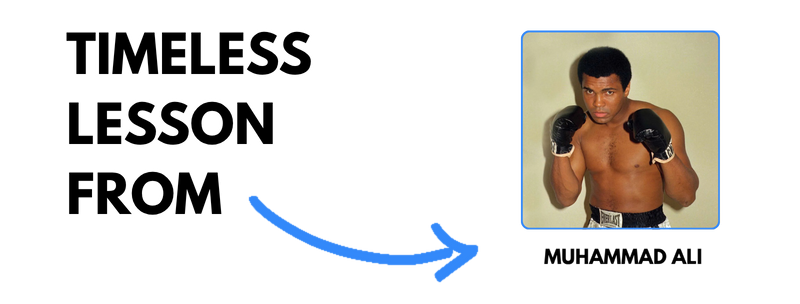
Stand Tall, Even When It Costs You
Ali lost more than money and titles when he refused the draft — he lost years of his career. But by standing firm, he gained something greater: integrity. His defiance showed the world that true greatness isn’t measured only in victories, but in the courage to live by conviction.
In the ring, he floated and stung. Outside it, he carried the weight of principle. That combination made him more than a champion — it made him The Greatest.

Ali’s story reminds us that values only matter when they’re tested. It’s easy to stand tall when the cost is small. The measure of conviction is whether you’ll hold it when everything — status, money, opportunity — is on the line. That is the kind of integrity that outlasts titles.
Until next time,
The Chronicler
This breakdown of Ali's sacrifice is powerful. Losing those prime years wasnt just about titles, it was about proving that conviction matters when everything's at stake. I remmeber reading about how even his critics later admitted he was right to stand firm. The part about integrity outlasting titles captures why his legacy goes beyond boxing.